Cedar Choppers and the Travis County Dog Wars
By Westlake Historical Society, adapted from u/s810 on r/Austin · July 6, 2019 · 4 min read
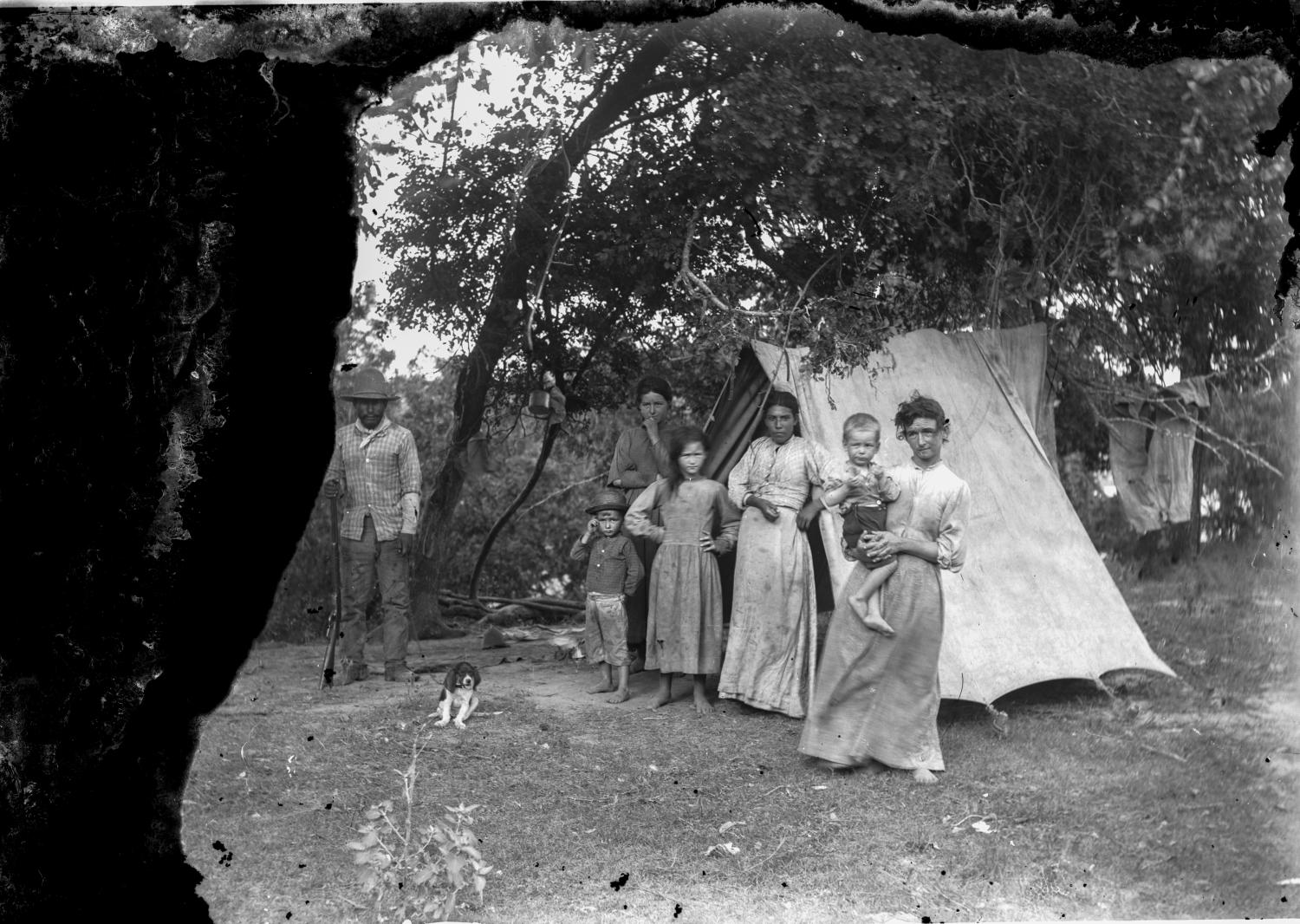
The country before the country
For a hundred years before West Lake Hills incorporated as a city in 1953, the hills west of Austin were home to the cedar choppers. They lived in rough cabins on the limestone ridges above the Colorado River, cut Ashe juniper — universally called cedar — into fence posts, shingles, and corral material, and hauled the loads down by wagon to the markets of Austin. The name was used both descriptively and dismissively. The families themselves were proud working people whose oral and material culture shaped the area long before anyone thought of laying out streets.
The redditor u/s810 — a long-running chronicler of central Texas history on r/Austin — published a substantial 2019 essay collecting the surviving fragments of cedar-chopper history into one narrative, drawing heavily on the Eanes History Center holdings (now part of this archive) and on Gary Cartwright's mid-century Texas Monthly profiles. We adapt the spine of that essay below with attribution; the full original is at the link in the citation.
What the children saw
The earliest visual record we have of the area comes from class photographs at the Eanes Rock Schoolhouse — the one-room building that served the cedar-chopper community along with the families of Eanes-area ranchers. Students sat for lunch on a pile of rocks outside the school in 1930; class trips to the Alamo were piled onto horse-drawn wagons stopped at gas stations. The photographs are now catalogued in this archive under the {" "} Eanes History Center collection.
What u/s810 emphasized — and what the photographs bear out — is that the Eanes school served two distinct populations: the children of established ranching families and the children of the cedar-chopper families on the ridges. They went to school together. They didn't necessarily mix easily afterward.
The Dog Wars, 1902–1923
The most-told set of stories about the cedar choppers concerns a long series of disputes with Austin sport hunters who came west into the hills with packs of trained hunting dogs. The dogs would chase deer across cedar-chopper homesteads — and the cedar choppers, who hunted the same deer themselves out of necessity, would shoot the dogs. Hunters would retaliate. Local lawmen rarely intervened. The disputes — known in Travis County folklore as the Dog Wars — ran from roughly 1902 through 1923, with the last shootings recorded in the year of the area's first paved road.
Emmett Shelton, Sr. — the storyteller whose recordings form the spine of this archive — touched on the period in his oral histories. So did Benton Beard. Their material lives in the Eanes History Center and in the {" "} Our Westlake podcast.
What the comments added
The Reddit thread itself drew substantial community response. We quote several substantive contributions with attribution:
u/ftf82 noted the proper name of the city:
> Fantastic article. One nit. It's West Lake Hills and not > Westlake Hills.
A correction we've carried into this archive's body copy.
u/GetBusy09876 added family experience:
> Glad to see cedar choppers get a shout out. I used to know and live > next to some, growing up in Kerrville in the '70s. There were a > lot more in the Medina River valley where my mother's people > were. We heard a lot of stories. A lot of them were moving into town > and there was a definite culture clash for a few years when I was a > kid. People disrespected them pretty badly. They had different > ways…
u/capthmm pointed at supplementary reading:
> As supplemental reading about cedar choppers in and around the > Austin area during the 70's, I can't recommend two > articles from Gary Cartwright, who has to be one of Texas' > greatest writers, highly enough. The Polk story specifically > mentions the cemetery next to the Rudy's on 360…
u/insulation_crawford named the standard text:
> I read The Cedar Choppers: Life on The Edge of Nothing last year, > and it was an excellent read. Highly recommended.
Ken Roberts's book — published by Texas A&M University Press in 2018 — is the modern scholarly treatment of the topic and the place to start for anyone who wants to read further.
Why it matters here
The cedar choppers don't map cleanly onto the West Lake Hills / Rollingwood / Eanes ISD geography that this archive otherwise organizes around. They lived across all of it — and across what is now South Austin and the Cedar Park area to the north — in a distributed network of homesteads that mostly disappeared as twentieth-century paving, dam construction, and subdivision arrived. But their descendants are still part of the community, and their labour is what kept Austin's fence lines and roof shingles upright for the better part of a century. They belong here.
---
This article is adapted from u/s810's {" "} [Old Austin Tales: Cedar Choppers & The Travis County Dog Wars](https://www.reddit.com/r/Austin/comments/c9tc4f/old_austin_tales_cedar_choppers_the_travis_county/), r/Austin, July 6, 2019, with comment selections quoted with attribution. The companion photograph is from u/s810's {" "} [Unknown Cedar Chopper Family in Rural Travis County](https://www.reddit.com/r/Austin/comments/10bpypl/unknown_cedar_chopper_family_in_rural_travis/), January 14, 2023.
Sources & Connections›
Documents
Collections
Source Notes
- Adapted with attribution from u/s810, "Old Austin Tales: Cedar Choppers & The Travis County Dog Wars - 1902-1923," r/Austin, July 6, 2019. https://www.reddit.com/r/Austin/comments/c9tc4f/
- Companion photograph from u/s810, "Unknown Cedar Chopper Family in Rural Travis County - 1900~," r/Austin, January 14, 2023. https://www.reddit.com/r/Austin/comments/10bpypl/
- Gary Cartwright, profiles of Travis County hill-country families in Texas Monthly, 1970s.
- Ken Roberts, *The Cedar Choppers: Life on the Edge of Nothing* (Texas A&M University Press, 2018).
Continue through the archive
Three threads that connect to what you just read. Pull on any of them.